1912 — 2006

Michiko
Toyama

外山 道子
Osaka · Paris · New York · Tokyo
Composer
Conductor
Acoustic Researcher

A Japanese composer — born in Osaka, educated in Paris, celebrated in New York. She broke every barrier placed before her, and when she faced a challenge, she found a way.

First · 01
First Japanese composer selected for the ISCM Festival
International Society for Contemporary Music, Paris, 1937
First · 02
First visiting composer and emissary at Columbia University's electronic music studio
New York City, 1956–1959
Work · 03
"The Voice of Yamato" — 56 years before Japan heard it
Premiered at the ISCM Festival in Paris in 1937, her composition was not performed in her homeland until 1993
Science · 04
Pioneering acoustic researcher of the Shakuhachi
Published numerous papers on the acoustics of the Shakuhachi from 1971 onward
01

A Life Across Three Worlds

Short Bio
Michiko Toyama (1912–2006)

1912
Osaka
Born in Osaka, Japan, on September 1, 1912
Born in Osaka to Sutezo and Haruko Toyama, her story begins in Japan, where music and curiosity about sound took root from the earliest years.
1930s
Paris
Studied under Nadia Boulanger — École Normale de Musique
Trained by the legendary pedagogue Nadia Boulanger, whose students included Copland, Bernstein, and Piazzolla. Michiko earned her place among the world's most rigorously trained composers.
École Normale de Musique, Paris
1937
Paris
Selected for the ISCM Festival — "The Voice of Yamato" premiered in Paris
Selected for the 15th Festival of the International Society for Contemporary Music (ISCM), the work premiered in Paris on June 21, 1937, sung by Ayako Ogino. She was the first Japanese composer to have a work chosen for the festival. It would not be heard in Japan for another 56 years.
15th ISCM Festival · Paris · June 21, 1937
1939
Paris
Baptized in Paris — then returned to Japan
Just before war broke out in Europe, Michiko was baptized in Paris and became a Christian. She then returned to Japan in 1939, leaving behind the world she had built over nearly a decade in France.
Paris, 1939
1940s
Japan
Married Kazuo — mother of Junko and Masashi
Back in Japan, she married Kazuo and built a family — their daughter Junko and son Masashi. Kazuo survived the war, but was taken to a labor camp in Siberia, Soviet Union, where he passed away. She became a widow with two young children.
Post-war
Paris
Returned to Paris — Milhaud & Messiaen, and Pierre Schaeffer
She returned to Paris after the war, leaving her two children in her family's care, to resume her studies at the Paris Conservatoire under Darius Milhaud and Olivier Messiaen. It was there that she encountered Pierre Schaeffer — the father of musique concrète — who introduced her to the world of electronic music, setting the course for everything that followed.
Paris Conservatoire · Pierre Schaeffer
1955
Tanglewood
Studied under Roger Sessions — Berkshire Music Center
She crossed the Atlantic once again, this time to study composition with the American composer Roger Sessions on a scholarship at the Berkshire Music Center at Tanglewood in Massachusetts, the summer academy of the Boston Symphony Orchestra.
Berkshire Music Center, Tanglewood · 1955
1956
New York
First visiting composer and emissary — Columbia University's electronic music studio
From 1956 to 1959, Michiko worked as the first visiting composer and emissary at Columbia University's electronic music studio, remaining there through the formal founding of the Columbia-Princeton Electronic Music Center in New York — one of the world's foremost laboratories for avant-garde and electronic composition.
Columbia University · 1956–1959
1957
1959
Performed at Carnegie Hall — May 26, 1957, and May 3, 1959
She had the opportunity to stand on the podium at a world-renowned concert hall, where her talent as a composer came to be recognized in America.
1960
Folkways
LP released — "Waka and Other Compositions" on Folkways Records
Her record Waka and Other Compositions: Contemporary Music of Japan (FW 8881) was released by Folkways Records (now Smithsonian Folkways) — a landmark LP of contemporary Japanese music that integrates electronic techniques and chamber orchestra with traditional poetry and themes.
Folkways Records FW 8881
1960s+
Japan
Returned to Japan — became an acoustic researcher
Back in Japan, she turned her trained musician's ear toward science. She analyzed the acoustic properties of the Shakuhachi (traditional Japanese bamboo flute), publishing a series of scholarly papers across international conferences from 1971 through the 1980s.
Shakuhachi acoustics research
1993
"The Voice of Yamato" performed in Japan — 56 years later
More than half a century after its ISCM premiere in Paris, her composition was finally heard in her homeland. A moment of profound, long-delayed homecoming.
56 years in the making
2006
Passed away on March 31, 2006, aged 94
A life of 94 years that spanned Japan, France, and America — concert halls, scientific laboratories, and every kind of barrier a woman of her time could face. She found a way through every one.
02

Waka and Other Compositions
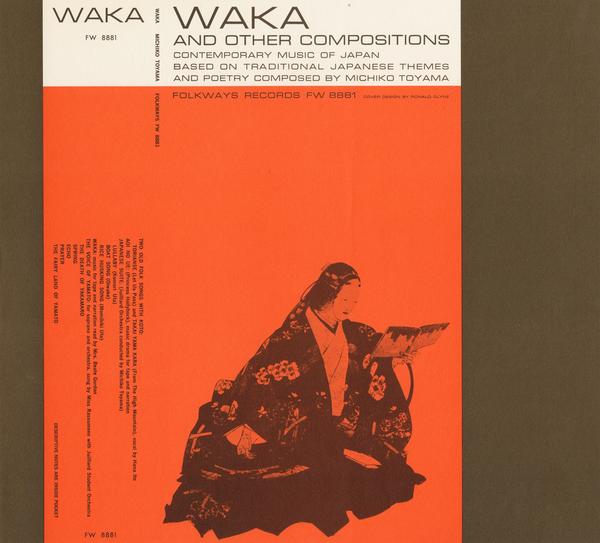
Waka and Other Compositions — Folkways Records FW 8881

Cover design by Ronald Clyne
Reproduced here in the context of Michiko Toyama’s recording history.
View the album at Smithsonian Folkways →

Waka and Other Compositions
Contemporary Music of Japan — Based on Traditional Japanese Themes and Poetry
Folkways Records · FW 8881 · 1960

Waka and Other Compositions: Contemporary Music of Japan (FW 8881), released by Folkways Records in 1960, reworks ancient waka through a contemporary musical language. Michiko Toyama draws on traditional poetry and folk forms, integrating chamber ensemble and electronic techniques.

Tracklist
01Waka (Part 1)
02Waka (Part 2)
03The Voice of Yamato: The Death of Yakamaro
04The Voice of Yamato: Spring
05The Voice of Yamato: Echo
06The Voice of Yamato: Prayer
07The Voice of Yamato: The Fairy Land of Yamato
08Torianse (Let Us Pass) / Takai Yama Kara (From the High Mountain) (medley)
09Aoi No Ue (Princess Hollyhock)
10Japanese Suite: Lullaby
11Japanese Suite: Oiwake
12Japanese Suite: Rice Husking Song
03

Acoustic research — the Shakuhachi papers

Over nearly two decades, she developed increasingly sophisticated acoustic models of the Shakuhachi — from spectral analysis of wet and dry bamboo tone, to ARMA synthesis models, to pole-zero modeling. A composer who became a scientist without ever ceasing to be a musician.

"When you face a challenge, you find a way…or make one."
— Michiko Toyama
War & loss
She lost her husband in a Soviet labor camp in Siberia after the war — an event that upended her world. With the support of her family, she rebuilt her life and career across two continents while raising two children.
Barriers of race & gender
As a Japanese woman in 1930s–50s Europe and America, she walked through doors no one had opened before her — and left them open.
A second life in science
At an age when most rest on their achievements, she reinvented herself as a researcher — bringing a composer's ear to acoustics.
04

The Waymakers Alliance

05

Members

IMJS: Institute for Japanese Cultural Heritage Initiatives, Columbia University
Barbara Ruch — Director Emerita
D. Max Moerman — Director
Ken Aoki — Executive Director
06

News

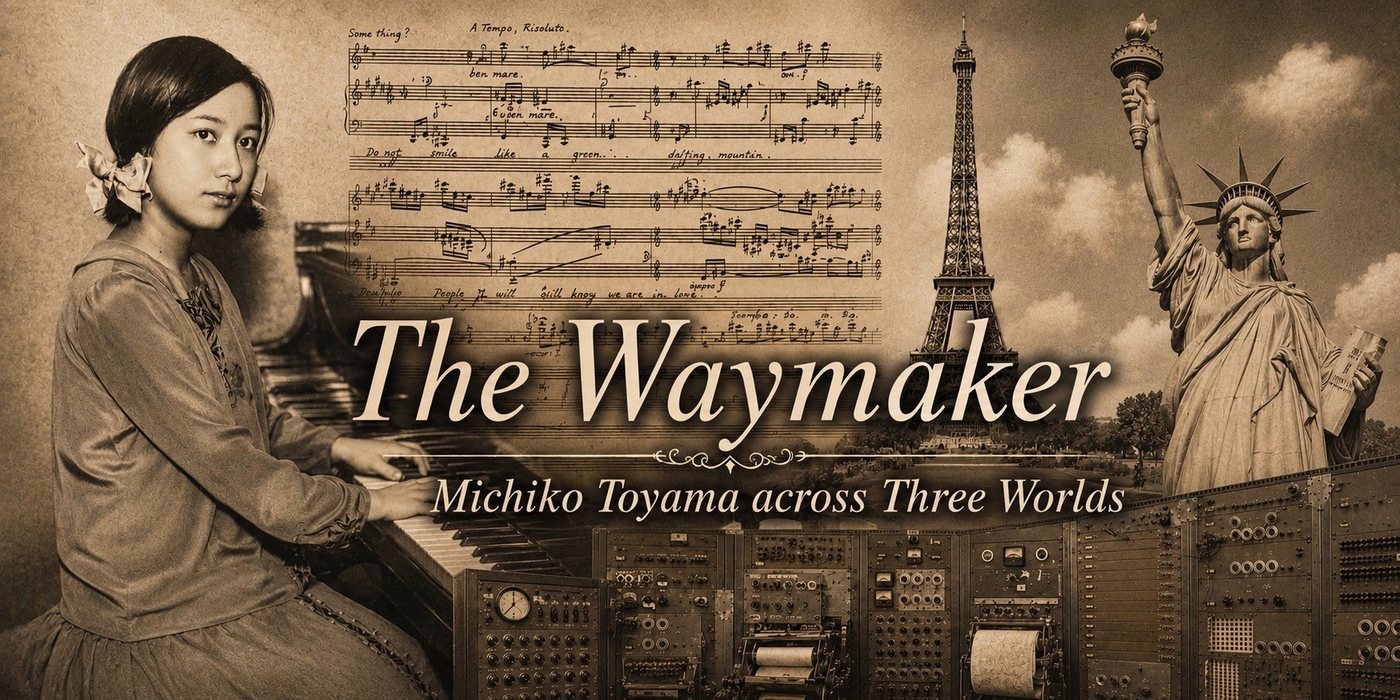
The Waymaker — Michiko Toyama across Three Worlds
The Mainichi · English edition
Monthly column on Michiko Toyama
Read at mainichi.jp →
07

Looking Ahead

Coming next
08

References

A Note on Ongoing Research

Research on Michiko Toyama is ongoing. Information may be updated as new primary sources and archival materials come to light.

09

Contact

the.waymakers.alliance.japan@gmail.com